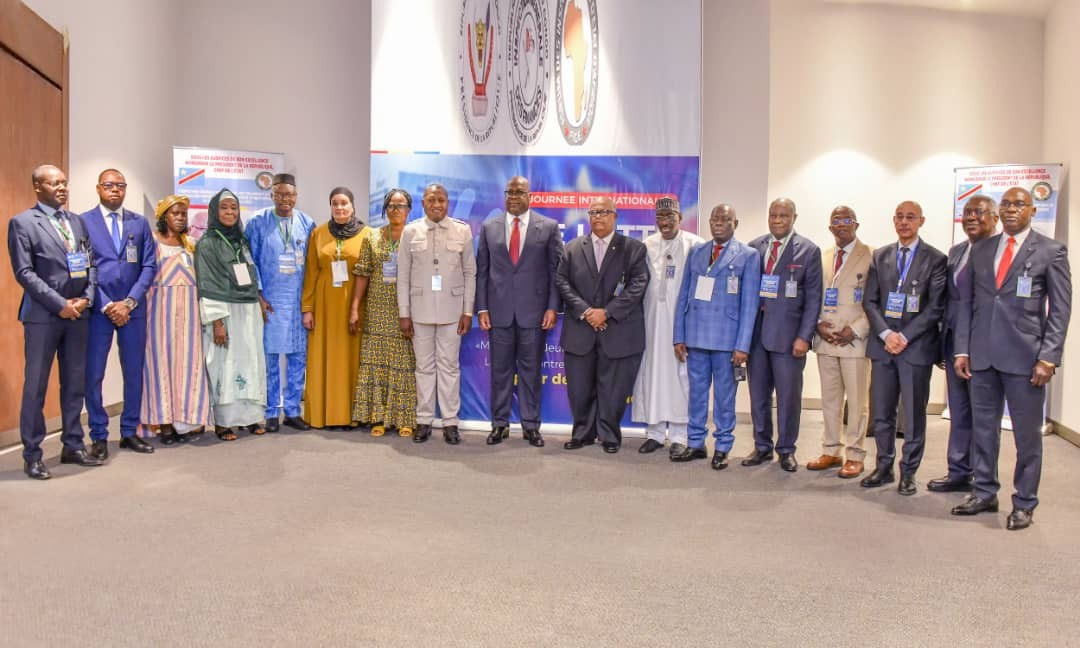
The General Inspectorate of Finance of the Democratic Republic of Congo (DRC) organised a commemorative conference on the occasion of International Anti-Corruption Day, under the patronage of the President of the Democratic Republic of Congo, His Excellency Mr. Félix-Antoine Tshisekedi Tshilombo. This annual event, held in Kinshasa, highlighted youth engagement in the fight against corruption and effective strategies for prevention and enforcement.
The main objective of this conference was to promote discussion and sharing of advances, initiatives and achievements in the fight against corruption and money laundering. The issues discussed included the organisation of the fight against corruption, the contribution of young people, the most effective initiatives and the main obstacles to be overcome.
Mr Hassan Issa Sultan, Executive Secretary of the Forum of African State Audit Institutions (FIGE) and Inspector General of the Republic of Djibouti, delivered the opening speech and expressed his gratitude to the President of the Republic of the DRC for his commitment and presence, and commended the efforts of the Inspector General of Finance of the DRC.
The Executive Secretary highlighted FIGE’s main achievements, demonstrating its dynamism and commitment to expanding international cooperation, as well as the importance of sufficient resources for supervisory institutions to effectively combat fraud and corruption.
His Excellency Mr Félix-Antoine Tshisekedi Tshilombo, President of the Democratic Republic of Congo, highlighted several crucial points in his speech:
- Youth Mobilisation: Young people are seen as the cornerstone of the fight against corruption.
- Prevention and Education: The importance of education and instilling a culture of integrity from an early age.
- Transparency: Need for transparency in procedures and use of modern tools to reduce opportunities for corruption.
- Strengthening of Control Structures: Renewed support for control structures such as the Court of Auditors and the General Inspectorate of Finance.
The President of the Republic concluded his speech by emphasising the need for a collective effort involving all sections of society in order to combat corruption effectively. He reiterated his call to all stakeholders to continue their tireless efforts in this mission, emphasising that the fight against corruption is not the monopoly of a few, but a collective effort by every citizen.
In his speech, Mr Alingete Key Jules, Inspector General of Finance and Head of Service of the DRC, highlighted three innovative initiatives implemented in the DRC. The first initiative is prior approval for all public expenditure. This preventive control improves the management of public funds by ensuring that all expenditure is validated before it is incurred. The second initiative is the financial patrol, a preventive control aimed at avoiding losses of funds and cracking down on acts of mismanagement. This proactive method enables financial anomalies to be detected and corrected before they become problematic. Finally, the third initiative concerns raising public awareness. Actions have been taken among different social groups to educate citizens about the dangers of corruption and encourage them to actively participate in its prevention.
Dr Farouk Hemici discussed the importance of prevention and detection in relation to fraud and corruption. He explained that prevention relies on education and public awareness, as well as the implementation of robust systems and procedures to reduce opportunities for corruption. With regard to detection, Dr Hemici emphasised the importance of regular audits and monitoring mechanisms to identify and address acts of corruption as soon as they occur. He also mentioned the importance of collaboration between different institutions and stakeholders in order to effectively combat fraud and corruption.
Mr Hassan Issa Sultan focused his speech on the importance of involving young people in the fight against corruption. He presented six strategic areas for raising awareness, educating and protecting young people. Firstly, he emphasised the need to raise awareness among young people about corruption issues from an early age. Secondly, he emphasised the importance of educating and training young people so that they can recognise and combat corruption. Thirdly, he encouraged the use of specific content tailored to young people to make the fight against corruption more accessible and engaging. Fourthly, he recommended using technology to reach and educate young people effectively. Fifthly, he emphasised the importance of reassuring and protecting young people who oppose or report acts of corruption. Finally, he concluded by emphasising the need to instil in young people the importance of defending the nation’s higher interests, in order to ensure responsible behaviour in the face of corruption in the long term.
Dr Yeo Adama, Member of the Council of the High Authority for Good Governance of Côte d’Ivoire (HABG), described the results achieved by the High Authority for Good Governance (HABG) in 2023 and 2024. He mentioned initiatives such as asset declarations, investigations and prosecutions, and national and international cooperation. He also highlighted the awareness-raising and education efforts carried out with public and private stakeholders, as well as coordination with other administrations. Dr Yeo acknowledged the weaknesses of the institutional framework, particularly the need for more widespread implementation of prevention structures and better coordination between the various anti-corruption bodies. He concluded by presenting the outlook for 2025, including the development of a national good governance index and the creation of the Academy of Good Governance and Anti-Corruption Leadership.
Mr Wycliffe Kato Mwebaze, from the Inspectorate General of the Government of Uganda, presented Uganda’s efforts in the fight against corruption. He emphasised the importance of involving young people, who represent 78% of the population, in anti-corruption initiatives. He mentioned the creation of integrity clubs in the education system, ranging from primary school to university, to educate young people about different forms of corruption and encourage them to adopt ethical behaviour. Mr Mwebaze also presented the implementation of the Whistleblowers Act, a law that rewards whistleblowers by awarding them a percentage of the sums recovered as a result of their reports. This strategy has made it possible to recover significant sums of money and punish those responsible for fraud. Finally, he emphasised the importance of communication and collaboration with all stakeholders, including local communities, civil society organisations, and religious and cultural bodies.
Ms Munira Ali, Secretary General of the EAAACA, emphasised the importance of involving young people in the fight against corruption. She emphasised civic education and the creation of integrity clubs in schools, as well as the use of digital platforms to raise awareness among young people and enable them to report incidents of corruption. Ms Ali also highlighted the commitment of the EAAACA, established in 2007, to cross-border asset recovery and capacity-building initiatives. She welcomed the accession of the DRC and Somalia, which strengthens the partnership and the effectiveness of the association’s actions. Finally, she highlighted the achievements of the EAAACA, including the strengthening of the legal and regulatory framework, the training of 2,000 people in asset recovery and financial investigations, and the creation of the Inter-Agency Asset Recovery Network in East Africa (ARIN-EA).
The presentation by Mr Paulo Alves, Director of the Legal and Trade Office of the General Inspectorate of State Administration (IGAE) of Angola, highlights Angola’s experience in the fight against corruption. It outlines the internal and external control mechanisms of the State, including the role of the National Assembly, the Court of Auditors and the specialised bodies reporting to the President of the Republic.
The General Inspectorate of State Administration (IGAE) has been strengthened to combat corruption more effectively, abolishing the old permissive model and integrating all inspection functions into a single entity. Several decrees have been adopted to restructure the IGAE, enhance transparency and regulate the declaration of assets and income.
Angola has also implemented a national strategy for the prevention and suppression of corruption (ENAPREC), aimed at preventing, detecting and suppressing this phenomenon through legislative and administrative reforms. The emphasis is on promoting integrity, ethical public procurement and a culture of whistleblowing.
Finally, he cited specific cases, such as the recovery of more than $7 billion in assets and property by the National Asset Recovery Service.